
No Beef, Less Meat
A simple change that reduces emissions and costs less -- available to us right now

The message is simple: eat no beef, eat less meat.
This blog will explore personal actions that make a tangible difference in addressing climate change. And this week the focus is on a choice we make every day: what we eat. The good news is that one of the most immediate and impactful steps we can take is also simple, cost-effective, and comes with personal health benefits.
This isn’t about total sacrifice; it’s about smart substitution and powerful change. There are very few individual actions that immediately cut a half-ton or more of CO2 equivalent (CO2e) emissions each year. Eating no beef and less meat is one of those changes. For me, this shift has saved money and aligned with my doctor’s suggestion to reduce my cholesterol intake. It’s a triple-win: planet, wallet, and health. And honestly, I enjoy the new variety of foods I eat.

Have you ever calculated the emissions that your dietary choices cause? HERE is a spreadsheet to calculate the annual emissions (tons CO2e/year) from your diet with instructions on the first tab. In this spreadsheet you account for your daily calorie intake to improve accuracy. Many other tools I have seen calculate dietary emissions without letting you understand the total calories of your choices - with the other tools it is impossible to tell if you are actually matching your food intake, and it is impossible to accurately compare different diets with the same caloric intake.
Why less meat?
Our appetite for meat, particularly in the West, raises our greenhouse gas emissions. The average American consumes about 220 pounds of meat annually, typically split as roughly ¼ beef, ¼ pork, and ½ poultry. This habit of centering every meal around a meat protein contributes to our emissions.
In general, a serving of meat – pork, chicken, beef, fish — causes more greenhouse gas emissions than a serving of high-protein vegetarian options like nuts, seeds, beans or lentils. Reducing meat intake significantly reduces emissions. The goal is not to punish ourselves for an occasional pulled pork or chicken sandwich, but to transition toward sustainable habits and meals. Simply cutting 90% of the meat out of your diet provides an enormous reduction in emissions. Substituting dairy products with alternate products like almond milk or cashew ice cream further reduces emissions. The point is not total, immediate perfection, but intentional, consistent change. By making this shift, we reduce our contribution to the global issue and signal to the food system that demand is shifting.
Why no beef?
While eating less meat is important, eliminating beef is paramount.
Cows are biologically different from pigs, chickens or fish. Cows (and sheep) are ruminants and have a more complex stomach with a rumen, where they pre-digest food. When cows swallow grasses and other foods we can not eat, specialized bacteria begin breaking the food down, creating methane as a waste product. They belch the methane back out into the air. This methane is a much more potent gas than carbon dioxide.
Ruminants include deer and other animals living naturally in many areas of the world. The problem with cattle is one of scale. We are currently raising a massive number of cattle to supply grocery stores and fast-food chains with the immense quantities of beef and dairy we purchase. Today, there are an estimated 1.57 billion head of cattle globally, while there are under 100 million deer worldwide. This difference in scale, driven by consumer demand, is why beef production is a major climate issue.
The immediate impact of choosing “no beef” is dramatic. When you stop eating beef - even if you simply substitute fish, chicken and pork in for the beef - you can cut over a half a ton of CO2e from your annual emissions of greenhouse gases.
To illustrate the impact, I estimated the annual CO2e emissions from four different diets all consuming 2,400 calories per day.
Standard American: A diet with typical meat consumption of 220 pounds per day and 1/4 of that being beef causes an annual emission of 2.13 tons CO2e/year.
High Beef: This same diet with 3/4 of the meat being consumed as beef causes an annual emission of 3.12 tons CO2e/year - a full ton per year higher.
No Beef: This same diet again except all of the meat is consumed as chicken, pork, fish causes 1.42 tons CO2e/year — even with the exact same amount of meat – 220 pounds of meat consumed per year.
Vegetarian: And if the calories from meat are shifted over to nuts, beans and lentils for a vegetarian diet with the same caloric intake, the emissions drop to 1.03 tons CO2e/year.
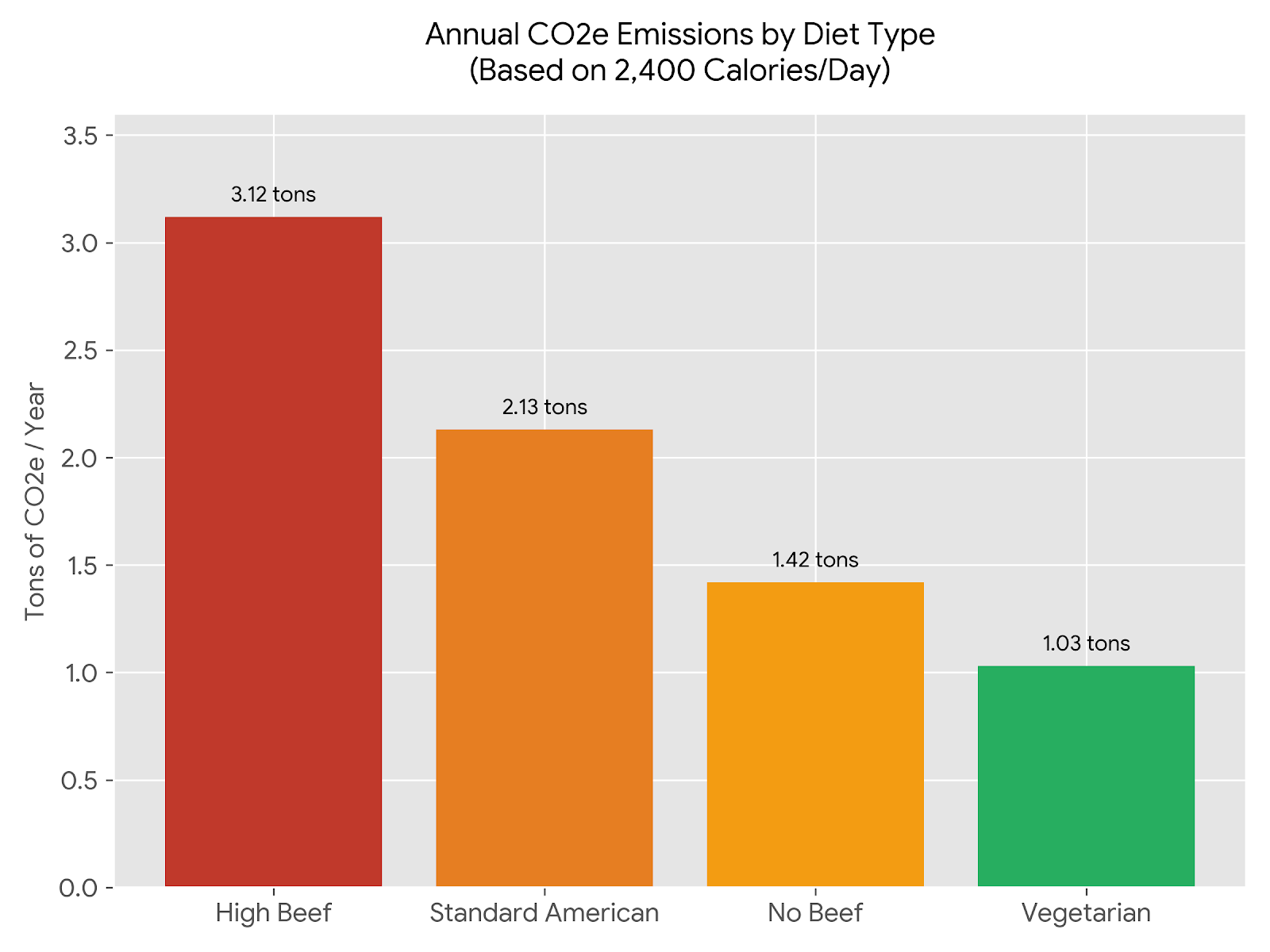
The jump in emissions between the Standard American Diet and the High Beef Diet (a full ton of CO2e) is startling and highlights the disproportionate impact of eating beef. Eliminating beef reduces emissions more than removing the rest of the meat (fish, chicken, pork) from your diet. But the additional shift removing (or significantly reducing) the remaining meats & dairy is also important.
An action for this week
Eat no beef and less meat.
For those of us concerned about climate change, the need to act is clear. Global emissions are the result of a series of choices by billions of people. We can choose to act differently and reduce the emissions we cause. It doesn’t take new laws or government mandates to change our behavior, but it absolutely does require intentional action on our part.
Changing our diet takes effort, discipline and a solid commitment. Next week we’ll use our diet to explore how to change behaviors. I can personally attest to multiple times when I tried to adjust my diet and within a few weeks found myself following my original patterns and behaviors instead of the new diet. Understanding some behavioral psychology will help us change and keep our new diet (and return to it when we falter).
If you are a quantitative thinker, a good first step is to understand your current diet. Use the spreadsheet presented earlier to calculate the emissions from your diet.
And if you are not into measurement and quantification - the rule of thumb is easy: Eat less meat and no beef. (And, yes, this extends into eliminating or significantly reducing dairy also.)
Jim
Every time you spend money, you’re casting a vote for the kind of world you want.
Anna Lappé
Subscribe to receive future posts
Want more information on emissions and diet?
If you want to find estimates of the emissions caused by specific food choices, a good source is the database of Food Impacts on the Environment for Linking to Diets (FIELD) compiled by food type, and assigned to the food commodities in the Food Commodity Intake Database (FCID) available at https://css.umich.edu/page/datafield.
A good metadata study on source of emissions for food can be found in Poore, J. and T. Nemecek. 2018. “Reducing food’s environmental impacts through producers and consumers. Science. 1 June 2018 Vol 360, issue 6392; pp 987-992. The paper is behind paywall at https://www.science.org/doi/10.1126/science.aaq0216, and a pre publication PDF not behind a paywall is available at https://josephpoore.com/Science%20360%206392%20987%20-%20Accepted%20Manuscript.pdf